


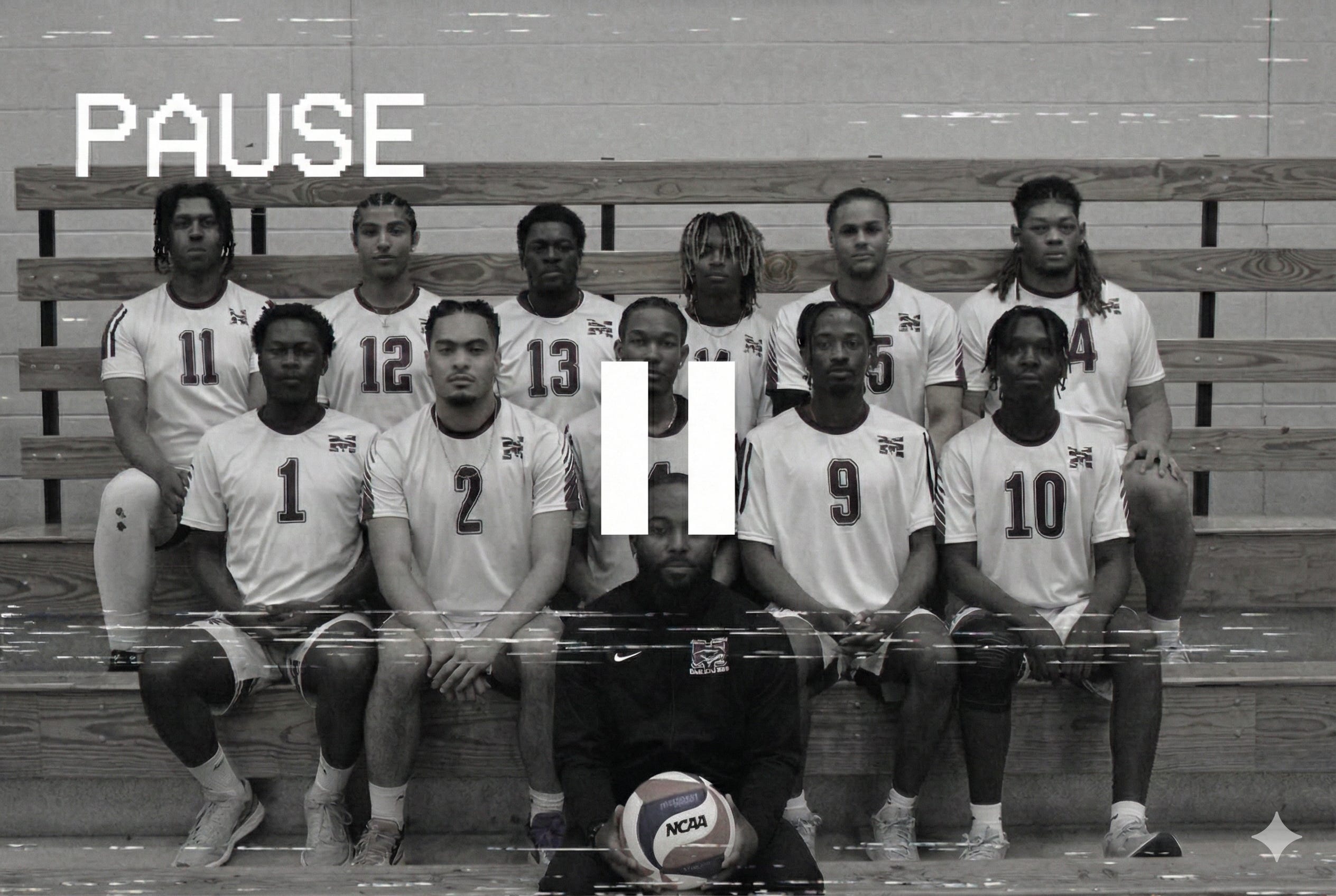
In just a few short weeks, the college men’s volleyball season will be starting, but not every program is returning. In addition to the highly publicized cancellation of the Grand Canyon University team, there will be another empty seat at the metaphorical table.
Although there has been no official press release, Morehouse Athletics Department has confirmed that “the Men’s volleyball program has been put on hold for the 2026 season.”
That’s right, there is another program having the door shut in their face. This time, no one seems to be talking about it. So, let’s change that, because growing the game matters.
A Brief History
In 2019, the Southern Intercollegiate Athletic Association (SIAC) announced the sponsorship of men’s volleyball. This was made possible by a $1,000,000 grant from First Point Volleyball Foundation and USA Volleyball. Each of the inaugural six programs received $150,000 over the course of three years.
Fast forward to 2025, and that initial funding has dried up. While the specifics of Morehouse’s funding situation have not been made public, it is hard to imagine that finances are not the driving factor in this decision.1
On the court, the Maroon Tigers struggled to find their groove at first. In their first season, Morehouse finished in last place in the SIAC with a record of 0-19. In fact, Morehouse lost every set they played that first season. Everyone knew there would be growing pains for a new program, but this seemed different.
Their second season was not much better from a statistical standpoint. Another winless season: 0-19. The silver lining, however, was that the winless set streak was broken. On April 6, 2023, Morehouse took set 3 from Kentucky State 25-22 and a silver lining started to shine through.
In year three, the Maroon Tigers lifted the curse and won their first match in program history on April 12, 2024 against Benedict College. The dramatic 5-set win was a welcome moment of joy for the third-year team. That season, they took sets in seven matches. The progress may have been slow, but there was progress!
In what could be the last season for the program, 2025, Morehouse finished with 3 competitive wins, all against first year program LeMoyne-Owen College. Again, the progress was there and this team was showing that they were getting better.
While funding may have been decreasing, the performance on the court was increasing. This only makes their absence this year that much more disappointing.
The SIAC Landscape
Morehouse was not alone when it began sponsoring men’s volleyball in 2022. A six team conference was brought into the collegiate men’s volleyball world. This was a giant leap forward for the sport that should not be overlooked.
Bringing in six programs and a conference to men’s volleyball is impressive, no matter how you look at this. For this to be the first HBCU conference for men’s volleyball was a massive step in the right direction for the sport.
Of the six teams originally announced, there are now only four left: Benedict, Central State, Fort Valley State, and Kentucky State. Paine College was originally slated to add men’s volleyball, but that team never materialized. Instead, Edward Waters rose to the occasion and started as the sixth team. Last season, LeMoyne-Owen joined the fun in the SIAC as the seventh team.
For the past two seasons, the SIAC has had an automatic qualifying spot for the National Collegiate tournament. This is a young conference with a lot of potential. These teams go out there all season and continue to play the underdog and end up surprising a bunch of people. It’s only a matter of time before these underdogs become the favorites more and more.
Record Keeping Issues
In spite of the hard work that the players and coaches have put into this Morehouse program, there are some big question marks. But maybe not the ones you would expect. The closer you get to the data, the more concerning the situation gets.
Let’s start with the high level: wins and losses. You would think this would be the easy part, but you would be wrong. Let’s look at the 2024 schedule, according to Morehouse Athletics.
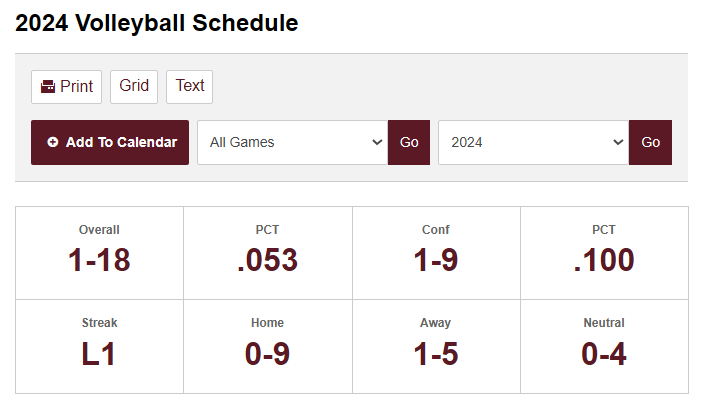
Now, let’s look at the same season, according to NCAA Stats.
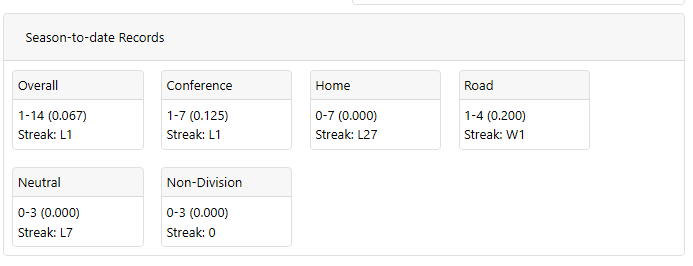
That’s right, they are different. This really comes down to how you record a forfeit. The fact that the official athletics website doesn’t match the NCAA Stats website is a problem. I wish this was the only example, but it appears to be a pattern.
More egregious, is the erasure of a coach from the Morehouse website. If you look at the inaugural roster, Morehouse lists the coach as Dr. Ashley Johnson. However, Dr. Johnson was the coach of the Maroon Tigers for their second season. Emory Lightfoot was the first coach of the program, as shown in the NCAA records.
This may feel like a clerical error, but not having the correct coach listed seems like a big deal. If a program does not have accurate record keeping for the easy things (like wins and coaches), how can we trust difficult things like player stats.
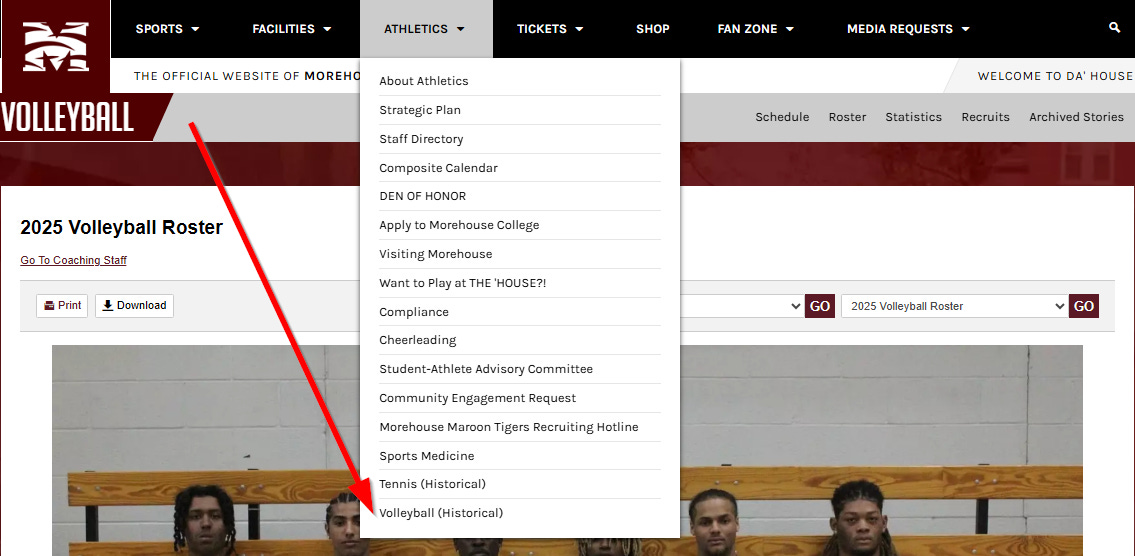
Today, if you go to the Morehouse Athletics website, you can still find the Men’s Volleyball page, but you have to look. Credit to Morehouse for keeping the page around, but moving it at all is not a great sign for the program.2
The Human Toll
I don’t want to overlook the fact that this program’s pause impacts real people. There are players who were recruited to play for the Maroon Tigers. They had hopes and dreams of competing at the collegiate level. Right now, those dreams are on hold.
Recruiting is difficult. It is even more difficult when there is a different coach every year and no consistency from season to season. These players have been battling this constant change and still showing signs of improvement.
There is also the area of scholarships. I have not heard how this is currently being handled, but it concerns me. The financial landscape of higher education is challenging, to say the least. Scholarships are a significant factor for so many student athletes. Having less of them to go around in a growing sport, does not help the situation.
I have talked to several former players and it is clear that they want the program to continue. There is pride in playing for Morehouse and putting on that maroon jersey. They told stories of travel difficulties, court time struggles, and disappointing performances. They also told stories of winning, and growth, and hope. This is a program full of players that want to succeed, but right now they are not being given the chance.
What’s next?
That is the big question. What is next for Morehouse? In talking with former players, there is not a lot of optimism that the program will return, at least right now. The team has transitioned to club status and is looking to compete with other clubs this coming spring.
Even as a club team, it seems like the deck may be stacked against them. Like almost every volleyball team in the country, court time is an issue. To make matters worse, the team recently discovered that several of their balls had been popped and their net was missing. The uphill trail of disappointment and frustration has continued for this team, but they press on.
At a minimum, the team needs a court to play on and the basic resources to make that possible. On a larger scale, the team needs support. Support from the administration. Support from a coach. Support from outside funding organizations. Support from the fans.
Will Morehouse volleyball make a comeback? I don’t know. But I do know that there are people in the volleyball community that want to support the growth of this game. I hope that those same people make it incredibly difficult to justify keeping these young men off the court next year.
Growing the game is hard. This is true from teams looking for their first win (like Morehouse) to nationally ranked teams who have made the final four (like GCU). Growing the game takes a lot of effort from a lot of people. Sustaining that growth takes even more effort from even more people. And when any team is taken away, it is a significant loss to the volleyball world.
My deepest hope is that this is not the end of the story. There are more stories to tell. There are more people that need to know about what is happening at Morehouse so that it doesn’t happen at other institutions. There are more conversations that need to happen in order for this team to return to the court.
I am still working on getting more details on the funding for this team. Hopefully there will be a follow up story.
I know this is about the men’s volleyball program, but it appears that the same thing is happening to the tennis team at Morehouse too.
I knew of this months ago and just like that one of thebmore prestigious Universities in the US is out of the Volleyball business. But it is not a school that the masses care about, nary a word about it.
Maybe just maybe we need to solidify the schools playing to maintain what we have.
We will lose another in a year as well but nary a word will be said there either.
Thank you for speaking on such a vital topic- these “temporary” investments we’re seeing while appear helpful up front, feel more and more like false hope as these situations continue to arise.